1:57 p.m.: Snowe’s announcement that she’ll vote for the bill today spread a ripple of excited whispers across the silent hearing room.
It’s getting interesting. Although I’m sure Snowe doesn’t count as a real Republican.
1:57 p.m.: Snowe’s announcement that she’ll vote for the bill today spread a ripple of excited whispers across the silent hearing room.
It’s getting interesting. Although I’m sure Snowe doesn’t count as a real Republican.
This video from the Nightly Business Report is not embeddable, but click here and the player should come up for you. There is a transcript, too.
Sen. Carper’s interview with NBR focuses largely on his proposal for states to create their own Public Options until the reporter asks him about the plan to create a federal Public Option and let states opt out. He pretty quickly acknowledges that new suggestion and moves the conversation to a discussion of the CBO scoring. If you are looking at the video, this starts around minute 2:00.
One of our commenters here remarked that we’d have to watch Carper as he works to protect the interests of his insurance company funders and tries to water this down. I think that this interview is the “tell” that Carper may not be nearly as interested in the opt out initiative as in the states create their own plan.
Always worth watching — since you can usually win with a bet that Carper will vote with his funders than for his constituents.
The CBO score (this is a pdf) was delivered on the Finance Committee bill this afternoon and the news is at first blush — good. Good in that it will keep the process rolling to its next step which is a vote out of Committee so the work at merging the HELP and Finance bills can proceed. Key highlights:
According to CBO and JCT’s assessment, enacting the Chairman’s mark, as amended, would result in a net reduction in federal budget deficits of $81 billion over the 2010-2019 period. The estimate includes a projected net cost of $518 billion over 10 years for the proposed expansions in insurance coverage. That net cost itself reflects a gross total of $829 billion in credits and subsidies provided through the exchanges, increased net outlays for Medicaid and the Children’s Health Insurance Program (CHIP), and tax credits for small employers; those costs are partly offset by $201 billion in revenues from the excise tax on high-premium insurance plans and $110 billion in net savings from other sources. The net cost of the coverage expansions would be more than offset by the combination of other spending changes that CBO estimates would save $404 billion over the 10 years and other provisions that JCT and CBO estimate would increase federal revenues by $196 billion over the same period. In subsequent years, the collective effect of those provisions would probably be continued reductions in federal budget deficits. Those estimates are all subject to substantial uncertainty.
By 2019, CBO and JCT estimate, the number of nonelderly people who are uninsured would be reduced by about 29 million, leaving about 25 million nonelderly residents uninsured (about one-third of whom would be unauthorized immigrants). Under the proposal, the share of legal nonelderly residents with insurance coverage would rise from about 83 percent currently to about 94 percent. Roughly 23 million people would purchase their own coverage through the new insurance exchanges, and there would be roughly 14 million more enrollees in Medicaid and CHIP than is projected under current law. Relative to currently projected levels, the number of people either purchasing individual coverage outside the exchanges or obtaining coverage through employers would decline by several million.
There are still real problems with this bill, but this is an uncontroversial score which should get this thing out of Baucus’ hands soonest.
You have to see it really, but there is a transcript here. Shep Smith had on repub Representative John Barrasso from Wyoming for a discussion of the Public Option for health insurance reform, which definitely did not go as the Representative likely expected. Not only is it remarkable that Smith understood the Public Option and how it fits into any reform effort really well, but the jaw-dropping thing about this interview is how utterly intolerant Smith is for the routine talking points. Barasso wanted to talk about “government-run health care” and Smith sets him straight. Barasso wanted to talk about Medicare cost and budget issues and Smith re-orients the conversation to noting how health care costs have gone up while insurance profits and lobbying costs have gone up. There’s definitely more at the video:
[youtube]http://www.youtube.com/watch?v=tT61GNLBclk[/youtube]
And a note to reporters everywhere — this is how you deal with the talking points.
…You lost your job?
Most people who recieve health insurance through their employer have never considered this possibility. Perhaps it’s time they did.
The latest Kaiser Family Foundation poll is out and the news is pretty good, actually:
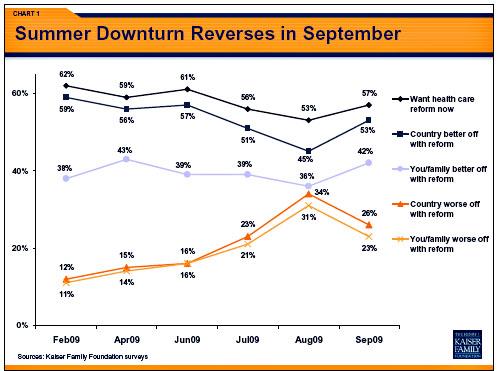
We’ve apparently recovered from the Summer of Spittle as The President got back into the game, as real bills came closer to closure, as the lies repubs were telling about the bills got sorted. Interesting findings from the poll above:
- Republicans and political independents became markedly more pessimistic about health reform in August, but those viewpoints softened in September. While 49 percent of Republicans say their family would be worse off if health reform passes, this is down from 61 percent in August. The percentage of independents saying they would be worse off fell from 36 percent in August to 26 percent this month. […]
- Fifty-seven percent of the public — including 56% of independents — say the GOP is opposing reform plans more for political reasons than because they think reform will be bad for the country. […]
- Fifty-seven percent of the public say they would support “having health insurance companies pay a fee based on how much business they have” and 59 percent would support “having health insurance companies pay a tax for offering very expensive policies.” In both cases, Republicans are evenly divided while Democrats and political independents tilt in favor. […]
- Seniors are still less convinced than others that health reform will benefit them, but they too have become less pessimistic since August. The share of seniors who think their family would be better off if reform passes climbed 8 percentage points from August, from 23 percent to 31 percent. Twenty-eight percent thought they would be worse off, and 33 percent said it wouldn’t make a difference. Fifty-five percent of seniors said they were ‘confused.”[…]
If anything, this indicates that Democrats do not need to be overly cautious here, and getting something done in November ought to be possible. It also means that the wingnuts will likely ramp up the scare tactics aimed at your grandparents too.
If he has any shred of integrity remaining, Tom Carper will have no choice but to oppose a filibuster of health insurance reform, even if it contains a robust public option.
Why? Because that has been his position on other key votes, even those that he allegedly opposes. Take his vote on Supreme Court Justice Samuel Alito. Please:
From the Booman Tribune:
When Samuel Alito was confirmed, only four Democrats voted for him (Tim Johnson of South Dakota, Kent Conrad of North Dakota, Ben Nelson of Nebraska, and Robert Byrd of West Virginia). However, the real vote was to invoke cloture. On that vote, the Democrats were much more generous. The following Democrats (in addition to the previous four) voted for cloture: Daniel Akaka of Hawaii, Max Baucus of Montana, Jeff Bingaman of New Mexico, Maria Cantwell of Washington, Tom Carper of Delaware, Byron Dorgan of North Dakota, Daniel Inouye of Hawaii, Herb Kohl of Wisconsin, Mary Landrieu of Louisiana, Joe Lieberman of Connecticut, Blanche Lincoln of Arkansas, Bill Nelson of Florida, Mark Pryor of Arkansas, and Ken Salazar of Colorado.
Progressives were furious with all of these Democrats who voted for cloture because they allowed Alito to be confirmed with less than 60 votes (he got 58 votes).
Note some of the other names on that list of infamy: Baucus, Lincoln, Landrieu, both Nelsons, Loserman, et al. But, OK, fair enough. The ‘adults’ insisted on an ‘up-or-down vote’.
However, if Carper now votes against cloture and effectively denies Americans a public insurance option when he supported cloture that led to a right-wing Court for likely a decade or more, then he will have demonstrated a moral bankruptcy in diametric, but hardly coincidental, opposition to his healthy campaign coffers.
We know he is morally and ethically bankrupt. His career proves it. Whether he’s willing to lay it all out there for everyone to see is another story.
Memo to Carper’s ‘Spokesman’: Can Tommy come out and answer questions on his own? Please? We can prepare them in advance if he’d like.
And with that, a challenge to DL readers: What questions do you want Tom Carper to answer? We will compile them. Keep them respectful and respectable, but don’t hesitate to ask pointed questions as he’s earned them. We will then do our best to seek answers from Delaware’s Most Famous Self-Styled Adult. And, of course, to keep you posted on our progress or lack of progress.
Via Steve Benen:
Sen. Jay Rockefeller (D-W.Va.) proposed a robust public option, with funding tied to Medicare rates. The final vote was not close — every Republican on the panel voted against it, as did Democratic Sens. Max Baucus (Mont.), Kent Conrad (N.D.), Tom Carper (Del.), Blanche Lincoln (Ark.), and Bill Nelson (Fla.). Of those, Carper’s opposition came as something of a surprise, as did Nelson’s vote.
The final vote, then, was eight to 15.
The Schumer Amendment is coming up for a vote — and his amendment adds a Public Option similar to the one in the HELP bill. Not tied to Medicare rates, but rates negotiated as if it were a separate insurance company.
Also via Benen– the Schumer vote is done:
The committee just voted, and defeated Schumer’s measure, 10 to 13. Two Dems who voted against the Rockefeller Amendment — Bill Nelson and Tom Carper — switched to support this approach, but Baucus, Conrad, and Lincoln still voted with the GOP.
So Carper did finally vote for a Public Option. Baucus is still shilling for his co-ops and the other two need to lose their seats.
This should not be in a first world country:
And don’t forget that Remote Area Medical pretty routinely conducts clinics in rural parts of the US, providing medical, dental and vision service to the uninsured.
You cannot lay claim to the best health care in the world if massive numbers of your citizens have to wait for a British charity to provide that care. Period.
Make sure you call Senator Tom Carper today to tell him to vote for a public option — because that is the only way to keep insurance companies honest and to ensure that everyone gets access to the best health care in the world.
Watch this video of Carper on CNN yesterday — captured by Jed over at dKos:
Oh yes, this will work. Cave in on the contentious 20% so the obstructionists can create another 20% to, you know, obstruct on. While I am really clear that Senator Carper is definitely sitting at the table for this health reform bill on behalf of his pharmaceutical and insurance funders — not on behalf of the people of Delaware — I am stunned that he can be so stupid as to still think that there is any bipartisanship to be had here. His so-called GOP friends are just looking to stop as much as they can — so how is it that Carper cannot see that he isn’t being played here? And played Big Time, too.
And children. I’m really looking forward to hearing social conservatives defend this…
“The point of insurance is to insure against catastrophic care costs. That’s what you’re trying to aggregate and pool for such things as heart attacks and cancer,” said an Anthem Blue Cross spokesman. “Having a child is a matter of choice. Dealing with an adult onset illness, such as diabetes, heart disease breast or prostate cancer, is not a matter of choice.”
This is now the insurance industry’s latest ploy – C-sections as pre-existing conditions. I’m not surprised since they are also labeling spousal abuse as pre-existing. I’m sure all the abusers are thrilled to add another weapon to their arsenal against their victim. Here’s to more control and intimidation! I can almost hear them saying, “Go to the hospital for that bloody lip/broken arm and then you’ll lose your health insurance!”
As a person who had an emergency C-section – and had to report it to my insurance company within 12 hours, or risk it not being covered – this new excuse for non-coverage takes my breath away. It is a classic example of acting as if the patient is in control, when it’s the doctor’s call.
But what’s really interesting is how social conservatives will view this pre-existing condition. Seems to me it’s not very pro-life. Also seems like it might actually increase abortions. Oh, what a dilemma!
…and show themselves to not be paying attention to one of the biggest legislative efforts of a lifetime.
Today The Editors (a term probably more symbolic than a reflection of the actual work being done) published an editorial in which they intone with all seriousness — Health plan will cost money: It’s time Washington admits it.
Where the hell have these people been all year? Beginning with hearings in the Senate a year and half or so ago though this spring and summer when actual bills have been written and voted out of various committees, there has been an incredible amount of work and horsetrading ongoing on on these bills. And the press has (some better than others) been following lots of the horserace (not as much on the features of the bills) — but one thing you do get if you are paying attention to this is that how to pay for it is complicated and contentious. But they are trying to pay for it.
So how do you — especially if your business is to watch these narratives — come away from the last few months not knowing that not only does Washington know that these programs will cost money, but that they are trying to pay for it?
Apparently the NJ Editors are following some radio talking head who wouldn’t be able to follow legislative ebb and flow if his life depended upon it. And now they’ve published this incredibly misinformed attempt at wagging their finger at a Congress and Administration that not only knows that this costs money, but has been very clear about attempts to pay for it and not add to the deficit.
Every health reform bill out there comes with a way to pay for the programs. Some are better than others and none of them is a silver bullet. I can’t tell you whether any one of them does what it says it will in terms of paying for itself perfectly. But not one of them pretends that these programs don’t cost money.
It simply amazes me that these people can get themselves worked up to scold people for non-existent reasons. The people in DC working on this are pretty clear (as evidenced by the bills they are producing) that they have to pay for this. They may or may not be successful at paying for these programs as they go. In this, however, they are not like the Bush Administration and their Republican Congresses who deficit-financed every single program they implemented — from tax cuts to Medicare Part D to their wars. That profligate deficit-spending deserved more finger-wagging than it got and it is remarkably brain-dead for the News Journal to discover the evils of deficits now, in the middle of a legislative effort that is pretty obviously trying not to add to it. If they weren’t trying to pay for this thing, it would have been passed by now.
Too bad the NJ doesn’t value its own column inches better than this.
Tom Carper (and other Senators) have been hyping a “fall-back trigger” for implementing a Public Option for health insurance reform. The Public Option has strong progressive support and is one of the last big questions to settle in this process.
Timothy Noah over at Slate has done interesting reporting on the history and effectiveness of legislative “trigger” options. And apparently legislative triggers turn out to be legislative duds. Offering the legislators who support them an interesting camouflage — a way to look wise and considered on a proposal by voting for the promise of a review and implementation of an alternative if the current solution is not working. Except in practice, these triggers are routinely ignored by Congress. Take the prescription drug trigger that Carper routinely holds up as an example:
In 2003, when Congress added a drug benefit to Medicare, it worried that its new program to provide coverage through private plans subsidized heavily by the government would prove ineffective. But a trigger to end the program focused only on whether these private plans would serve all regions of the country, which they did. The trigger failed to address the real problems that emerged: fraud, abrupt changes in formularies and drug charges after beneficiaries signed up, and high costs. Meanwhile, a separate trigger in the bill required the president to address projected shortfalls within 15 days of receiving notice that 45 percent or more of Medicare funding was drawing down general revenues. Congress would then appropriate the necessary additional funds under an expedited procedure. But when President Bush notified Congress in 2006 that the 45 percent threshold had been exceeded, Congress did nothing. The threshold has been exceeded every year since then. Congress continues to do nothing.
So Carper holds up as a middle of the road option this trigger scheme, when if fact, it doesn’t quite work for the example he is so very proud of.
There’s more, too — David Sirota has written in his column and over at Open Left how “triggers” killed the effort to allow reimportation of drugs:
a group of congressional progressives and maverick Republicans waged a battle against the pharmaceutical industry and for a bill to allow the reimportation of prescription drugs from other industrialized nations. It was (and is) a commonsense proposal – other industrialized nations allow reimportation, and that reimportation helps lower prices by allowing consumers to buy FDA-approved medicines at the lowest world market price.
[…] So rather than kill the bill outright, the congressional Republican leadership and the industry hacks in both the Clinton and Bush administrations came up with a “compromise.” The bill could be passed and the celebratory press releases could be written, but only if the underlying legislation quietly gave the Secretary of Health and Human Services the final trigger power to ultimately implement the reform. Specifically, the Secretary would have to certify that imported medicines were 100 percent “safe” (at the time, the drug industry was pushing the lie that imported medicines from places like Canada were totally unsafe – prompting one honest Republican governor to ask, “where are the dead Canadians” from all the supposedly unsafe medicines).
This trigger provision, of course, made sure reimportation was never implemented at all, as no HHS secretary has agreed to sign any certification. As this New York Times story showed, the trigger was a well-calculated poison pill written by the drug industry. Hence, Americans are still legally barred from wholesale reimportation of medicine. […]
And as Sirota notes, ABC News is reporting that Carper and other Dems are advocating this “trigger” business with the President:
“If there is no meaningful competition after a couple of years, we would create competition through a public plan,” said Sen. Tom Carper, D-Del., in an interview with ABC News. “I think that could end up being the compromise because it bridges the differences between those who are for a robust public option and those who are adamantly opposed to a public option.”
“I raised it with the president,” Carper continued, referring to his public option with a trigger proposal.
So I think we have our answer about Carper and the Public Option. He is a NO vote and is hiding behind this trigger to avoid saying NO.